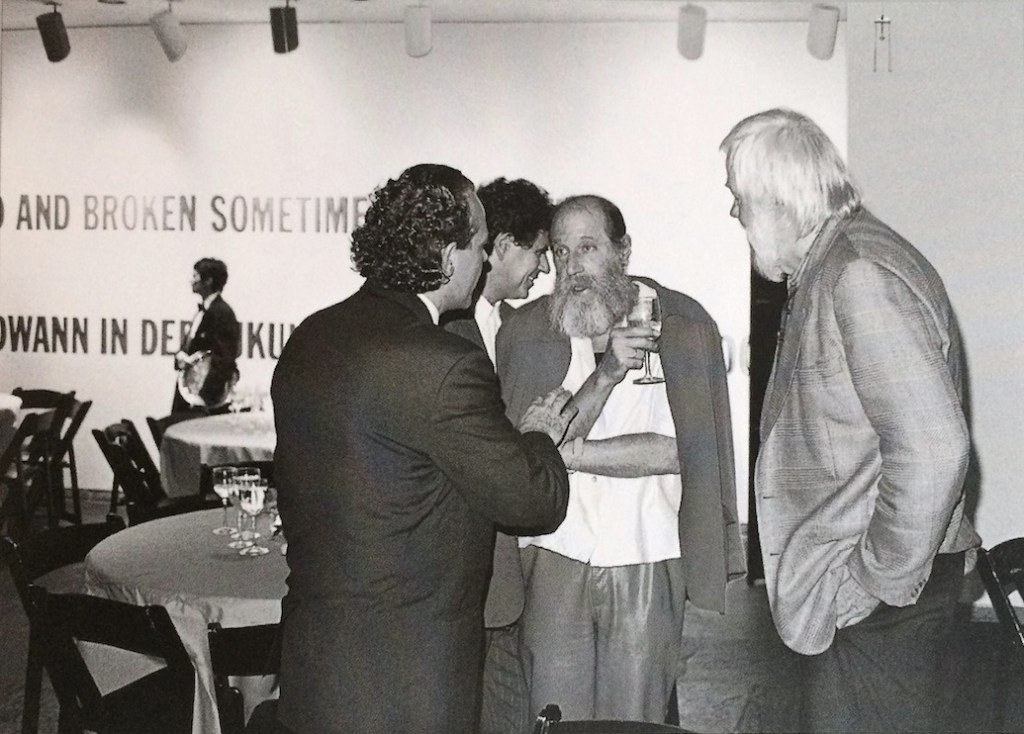
Dear John: John Baldessari in Conversation with Rolf Lauter. Sprüth Magers Berlin, September 2013. Interview in sleek 40, winter 2013/14, 44-49.
I met John for the first time in New York in 1995 while preparing the large dialogue exhibition „Views from abroad: European Perspectives on American Art“ (Whitney Museum of American Art New York / Museum für Moderne Kunst Frankfurt 1996/1997). I still vividly remember his sampling photo work „Ashputtle“ from the collection of the Whitney Museum we discussed a long time. At the end of 1996 we met at the opening of the first part of the project at the Whitney Museum in New York and at the end of January again at the opening of the second part of the exhibition at the Museum für Moderne Kunst in Frankfurt. Since then, we met in Santa Monica, Los Angeles in his studio, several times in New York, and in Berlin. In the Frankfurt Museum, I was able to show groups of works from the Tetrad Series, early image-text works and photo collages in „change of scene“ exhibitions between 1997 and 2002.
In late 2013 I was asked to do an interview with John as part of the exhibition of his work group STORYBOARDS (IN 4 PARTS) in the Berlin gallery SPRÜTH MAGERS, which was published in the issue of the magazine sleek in late 2013 (Vol.40, winter 2013 / 14, 44-49). This interview brought me back to one of the most wonderful, intellectual and energetic people, one of the most authentic contemporary artists, and one of the most influential mentors for younger artists.
I am forever and deeply grateful to John for many insights into art, culture, politics and society.
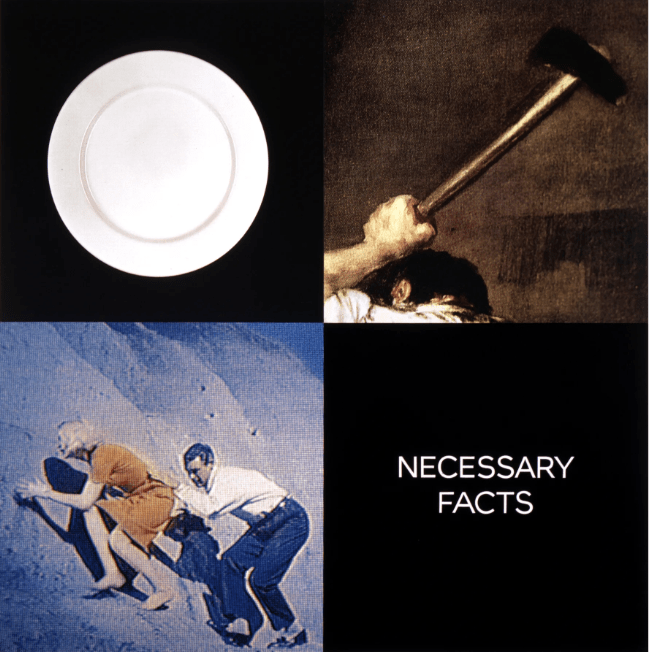
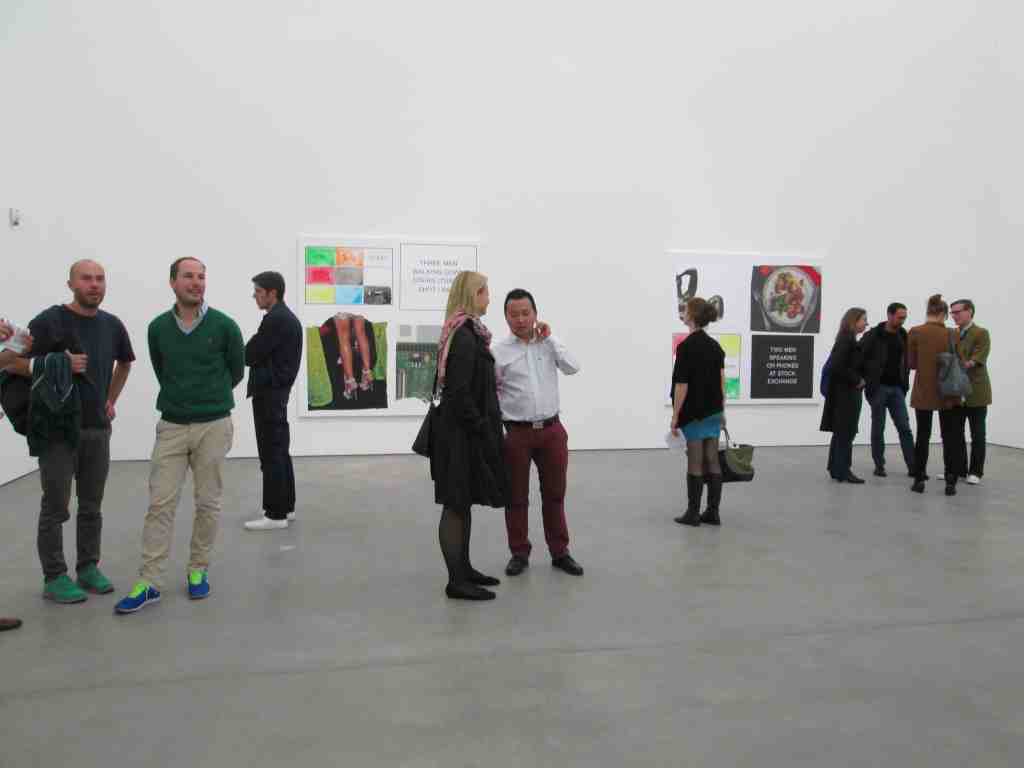
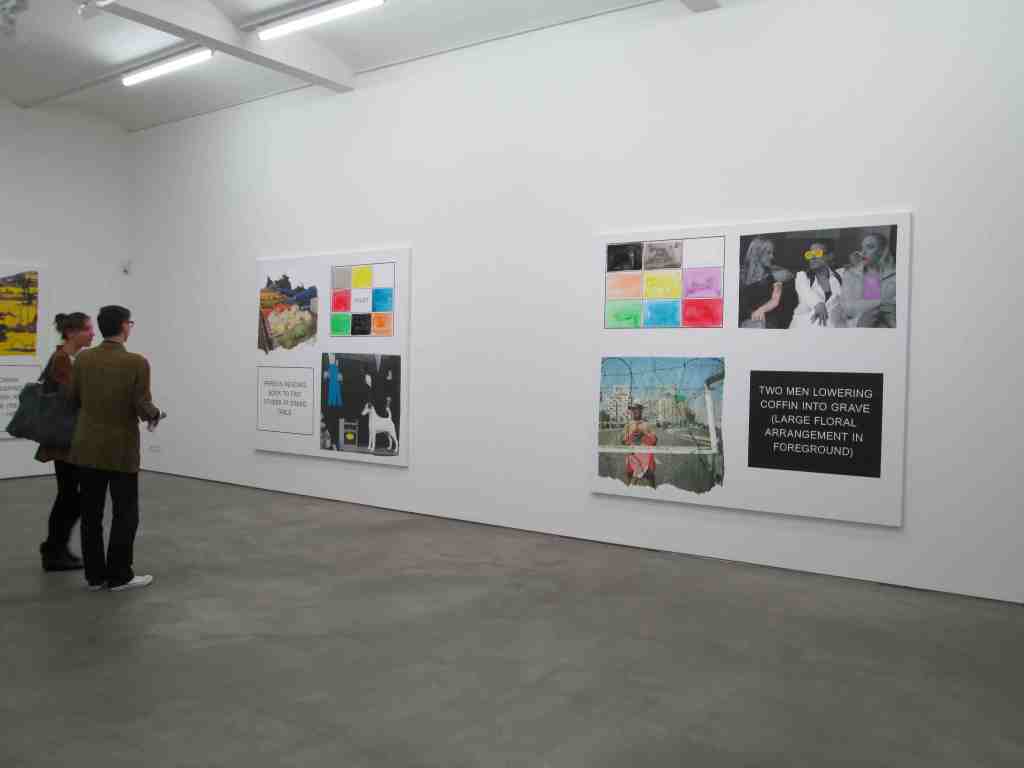
STORYBOARD (IN 4 PARTS) SPRÜTH MAGERS BERLIN SEPTEMBER 14 – NOVEMBER 02 2013
Rolf Lauter: What was your first consciousness of being an artist?
John Baldessari: I studied art in college and then did art history. I supported myself by teaching art in schools, I painted on weekends and I pretty much thought that would be my life. But I just thought art was masturbation – it didn’t really help anybody. I wanted to be a social worker, do some good in the world. And then I had, well, I call it an epiphany: I taught young kids in the California Youth Authority, who were too young to go to prison but were in a prison-like situation. The public school system provided education, so they hired teachers that were really big in size, like me, for keeping the kids in control. And I saw that these kids, who were future criminals, cared more about art than I did! And that made me think there is a need for art in the world. It was important for these kids, who were going to be criminals as far as I could see. Art did have some use – I didn’t know what kind but I could see it had some – maybe spiritual nourishment or something like that, I have no idea. At that point I decided I was going to be an artist.
What was your motivation for making, in the Sixties, the first pictures you did with a camera – did you want to show your immediate environment?
John Baldessari: It was multidetermined. I was living in a little ghetto community outside of San Diego National City. I thought I would probably live there all my life and teach art in high-school and paint on weekends. I was doing art for myself. And because I thought nobody cared, I could do anything I wanted. The complaint you would hear at the time was, because it was in the midst of Abstract Expressionism, people said “my kid could do that”. So I thought, what if you give people what they want? They probably read newspapers and magazines, they probably have cameras and take pictures, I’ll do art that’s just text or texts and photographs, like in a magazine, and I’ll just put it on canvas – that’ll make it art, because it’s on canvas. It seemed a perfectly logical assumption to make, but I didn’t have any success with those either.
In that time you started to combine photographs with text. Was the text constructing a second part or did it continue in the same direction of meaning?
John Baldessari: Same thing. I consider a text as important as an image; they’re of equal value. So I can do something that is all text, text and photo or just photo, and it didn’t matter. I was just trying to get away from traditional painting.
So you started to create a very specific structure, where you included found imagery. Is this structure of combination, sampling, bringing different elements of content and contexts together a principle of your thinking and your art in general?
John Baldessari: I think so, yes. The way I learned art, it was a single sculpture, a single painting, and I never questioned that. But when I got into photography I realised I could have multiple photographs, multiple imagery, it didn’t have to be this one image, and it made sense for me philosophically because there’s not any one truth. I think, sometimes, you can have contradictory truths together, the world is more about multiplicity than just one thing, being one-dimensional. Very seldom have I used just a single image any more because I think that’s false. Art in one way you could say is a conversation, and I think when I’m talking to people I’d like to ask questions more than give answers. I like to suggest things rather than say “this is the way it is.”
If you create an image with, say, a chair, an apple, and a face from a Goya painting, what makes it different in the painting?
John Baldessari: What makes it different is that you see that the Goya in a different context, and the chair in a different context, and the apple. And you can ignore it, and say, “oh it’s a picture of Goya and all this other stuff”, but it would be like a doctor ignoring different symptoms and only focusing on one. It’s up to you.
Is art a creative act that starts with an image, a situation, a process or is it a direction pointing to a larger structure?
John Baldessari: I don’t have a clear answer for that. [Art is] having some sort of passion for doing what you think art might be. I don’t think I had any passion for it before I had this epiphany, and then, once I decided that I was going to be an artist, I decided that I was going to be the best artist I knew I could possibly be. I don’t know how you go about doing that. You just do what you intuitively think you should be doing.
Is perception a fantasy, completely subjective or is it a dialogue between the artist and the viewer through the painting?
John Baldessari: Ideally I think it’s a dialogue. But you never hear the conversation. I think it sounds very elitist but I also think art is a conversation with other artists, because we all look at each other’s works. I say something and if I think it’s good, I think another artist is going to say something back to me by what he or she does. And I might respond the same way. It’s a conversation with works.
Your works are not systematic; they’re intuitively organised and for me, in some way they mirror the world.
John Baldessari: I’m more a listener than I am a dictator. And based on what I hear, I do my work. I’m making judgements of course. I’m saying my responses to what I’m experiencing. I distrust conventional logic; I have an absurdist view of the world, which might be why I appreciate Dada and Surrealist artists and Duchamp. Bit I also love Matisse, and I love Giotto, and that’s my toolbox. I distrust conventional opinion. I would rather listen to what an artist has to say about the world than a politician.
Does that mean then that artists have a certain responsibility to comment on the world, to give an alternative reading of things?
John Baldessari: No, I think artists have a responsibility to themselves. I don’t think artists should be burdened with responsibility. Shakespeare wrote, “‘be true to yourself and you can’t be false to anybody.”
You once said that whenever you go to a museum, you see an image as a part of a film.
John Baldessari: It goes back to my distrust of a single truth. A single painting seems to be one truth, but if that image was not a painting but a frame in a film instead, you wonder what were the frames that came before and after. Or, if you had a wide angle shot, what would you see that’s not in the painting. Art is about editing, we don’t think it’s about that, but it’s about what you’re leaving out. Also, it’s about the times. de Kooning said that a masterpiece is only a masterpiece if it speaks to the present. If it doesn’t say anything to us than it’s dead. You can say that about any art, I think. Some art is dead, some art is not. But that doesn’t mean that 20 years from now dead art can’t be alive again.
If I understand it well, reality is a very open structure for you.
John Baldessari: I don’t know what reality is! I’m not prepared to speak about reality. I don’t know what reality is. I guess this is real (knocks on table). Does a table have any more reality than a thought? I don’t know.
What is the source of your interest artistically. Is it everything you see?
John Baldessari: Everything I see, everything I hear. And more than that, an old friend of mine was the critic Lucy Lippard, and I remember running her place one summer and she had a great library, and she had a little piece of paper pinned up on the wall, and on it was written “and on the other hand”. She didn’t believe everything; for anything you say you can think of something opposed to that.
You once included the words “Real shadows” in a work from the Tetrad series. There was a scene from a Goya painting, a minimal sculpture with a shadow, a film still in black and white and the text. Is a shadow in some way real? Or do you want to ask us?
John Baldessari: It was from Pessoa’s writing. He said “real shadows”. In one way it’s an obvious contradiction, people are going to say, shadows are not real, and he was saying “real shadows”, and I like contradictory statements… and the idea of a shadow being real, and also Goya who was a master of light and dark… I mean you can begin to make these connections; at least I can, very easily.
Would you say your work is the simplicity of complexity?
John Baldessari: Well hopefully it’s both, simple and complex. That’s why I like Matisse, why I like Goya. And I hope I don’t repeat myself. Then I’m just a hack. I hope I continue to say something new – other people might not read it that way – but otherwise I’d just be making a product.
In the new works you included colour plates. Is this a more abstract thinking in your work?
John Baldessari: It’s an adjunct. I can’t separate it out. You have four things there. The One section with the colour notation is about the way a filmmaker might have notes for how a film is supposed to look. And that’s the way I’m presenting them, these are abstract distillations of the look of these images. I can have a picture of you and it will be what you are wearing, it will be this and that colour, and say these are the colours you felt best about today. It’s an abstraction, a distillation. It says something about you, absolutely, without the interference of the face or the hair. Or anything else. It’s about the way you were thinking about yourself today as you dressed.
Do you have a vision you would like to realise?
John Baldessari: After many decades of doing art and thinking about art most of my waking hours, I hope I’m getting better and better at it. And I’m curious to see what will I come up with next. I’m at a point where I have command, like a composer, a thorough understanding of all the instruments available for me to make a symphony and I’m interested how I’m going to use those. I will keep the best parts of what I did last and get rid of the parts I thought didn’t work so well. It’s always a distillation, to get to a purer and purer statement.
Since that moment of epiphany about art, have you ever had doubts about art again?
John Baldessari: No, I haven’t. I don’t doubt myself, I doubt that area of knowledge we call art that has become contaminated by money. Sometimes I think I’m not making art I’m making trinkets for rich people. Yeah I have my doubts. But I say, I can’t help it, I just have to be true to myself. […] You have to be a master navigator. I’m not starving. I can say no to certain things.
Thank you John!
[to see]
 Rolf Lauter Art Blog
cool artist
LikeLike