„The true artist helps the world by revealing mystic truths“ Bruce Nauman
Since the origins of mankind, painting and its expressiveness determined by subjective identity has been its true and most honest companion of ritual, religious, magical, mystical, spiritual, emotional, reality-based or imaginative and creative processes of imagination. Painting is thus a pictorial expression of the visible external or imaginative inner reality of a human being. With it, the artist penetrates into the deepest areas of consciousness and unconsciousness, creativity, the consideration of reality, the visionary, the thinkable or the unutterable. And although the end of painting has often been postulated, artists are constantly reinventing new paths, creative processes and expressive possibilities in order to visually show people their individual truth, longing, passion, critical conception or worldview.
Even though photography, video, animation or new media in general advance to the deepest depths of microcosms, macrocosms, real and virtual worlds with the help of the latest techniques, sculpture continues to expand through the enrichment of the object or the space-installation intervenes in or metaphorically simulates the areas of factual reality and architecture has made groundbreaking border widening due to elaborate technological developments, nothing comes close to the meaning of the picture in its function as a unique, authentic, man-made work. Hans Georg Gadamer has impressively described this uniqueness and truthfulness of the picture in his famous text „Truth and Method“ by using hermeneutics. Through the mutual dialogue between painting and viewer, he has thematised and gradually worked out the concepts of truth, meaning, knowledge and understanding.
How is the artistic picture different from all other pictorial worlds?
Every day we are exposed to a flood of real or virtual images, events, processes, information that our consciousness and subconscious mind can hardly handle. The speed of computer-generated information and image worlds are structuring and determining today more than ever our lives, our civilizing everyday life. Paul Virilio has in his book „Racing standstill“ (original title: L’Inertie polaire, Essai. Bourgois, Paris 1990) described in an urgent way, how a human being in an ever-increasing flood of audio-visual images and information passes in the digital workplace and private world gradually into a state of stagnation, immobility. The screen becomes a substitute for reality and evokes a permanent omnipresence of universal presence in the immediate vicinity. The „order of succession“ is increasingly replaced by the „disorder of simultaneity“. The physiologically tangible three-dimensional space and with it spatial-temporal distances on the one hand and the successive real events on the other hand are filtered out of the tangible reality and condensed in a virtual two-dimensional simultaneity on our small or large screens. The laws of space and time are in some way abolished and the human being loses more and more the relation to the sensible reality. He moves away at a tremendous pace from his naturalness and thus from his sensual, aesthetic, authentic perception.
And this is where painting and the picture created by an artist play an essential role in our understanding of the world. Initially, a picture is a medium in its function and gives something back which it itself is not. By its nature, a picture is nothing more than canvas, stretcher and paint. In terms of its content, every painted picture is unique, something unique created by an artist. The medium picture is, so to speak, the mediator between the artist and the viewer, i.e. the dialogue platform between them. And just because of its uniqueness, authenticity, individuality, the painted picture differs from any other reproduced image in photography, video or digital media. In his brilliant essay “ The Work of Art in the Age of Mechanical Reproduction“ (1936), Walter Benjamin worked out this special significance of the work of art in high linguistic eloquence. According to Walter Benjamin, the work of art unfolds its own special aura, which is created on the basis of the spatial and temporal experiences stored in it as a visual expression. The significance of the uniqueness of the picture, originating from the „here and now“ of the creative process, thus develops a specifically magical and auratic effect that no other medium can unfold.
Lou Ros uses this „auratic“ moment of painting in an impressive way in order to convey to the viewer of his pictures specific messages in a subtle and painterly highly sensitive way. First and foremost, the artist is concerned with painting, a painting that nobilitates the applied colors on canvas in a mostly large-scale, flowing and sometimes with delicate contours accentuated brushstroke to „icons“ of natural being, becoming and passing. This is especially true of his new group of «Landscapes». Color is fed with the power of symbolism, becomes the very source of energy and mirror image of vast processes of a creeping and perhaps unstoppable change of nature from organic beauty to haggard, morbid, dead matter. At first glance, we see soft horizons, beige mountains, sandy beaches or blue sea in the sunset and it seems as if there is even a touch of romance over the landscape images … Lou Ros uses the principle of indistinctness in these landscape paintings, the softness in the painterly expression, in order to direct the viewer’s consciousness more to the subject he desires. Gerhard Richter masterfully developed this technique in many works, most recently in his series of pictures on the events in Stammheim on the “October 18th, 1977” https://de.wikipedia.org/wiki/18._October_1977
Lou Ros’s paintings are virtuoso and worked out in the highest form of abstraction: the subject „nature“ is reduced by the artist to the essential, i.e. to image-filling, extremely simplified, softly painted areas of color, which in very mixed shades develop a very “natural” expression. Thus, the artist does not so much indicate a specific place or object in the picture, but rather tries to sense a state in nature and to express it with emotional sensuality. Nature develops in the painting of Lou Ros like metaphorically condensed moods, which on the one hand evoke memories with positive experiences of nature, on the other hand, on closer inspection, a creeping, unpleasant feeling of vulnerability arises in our world and we seem to be dealing with seemingly incompatible forces of nature.
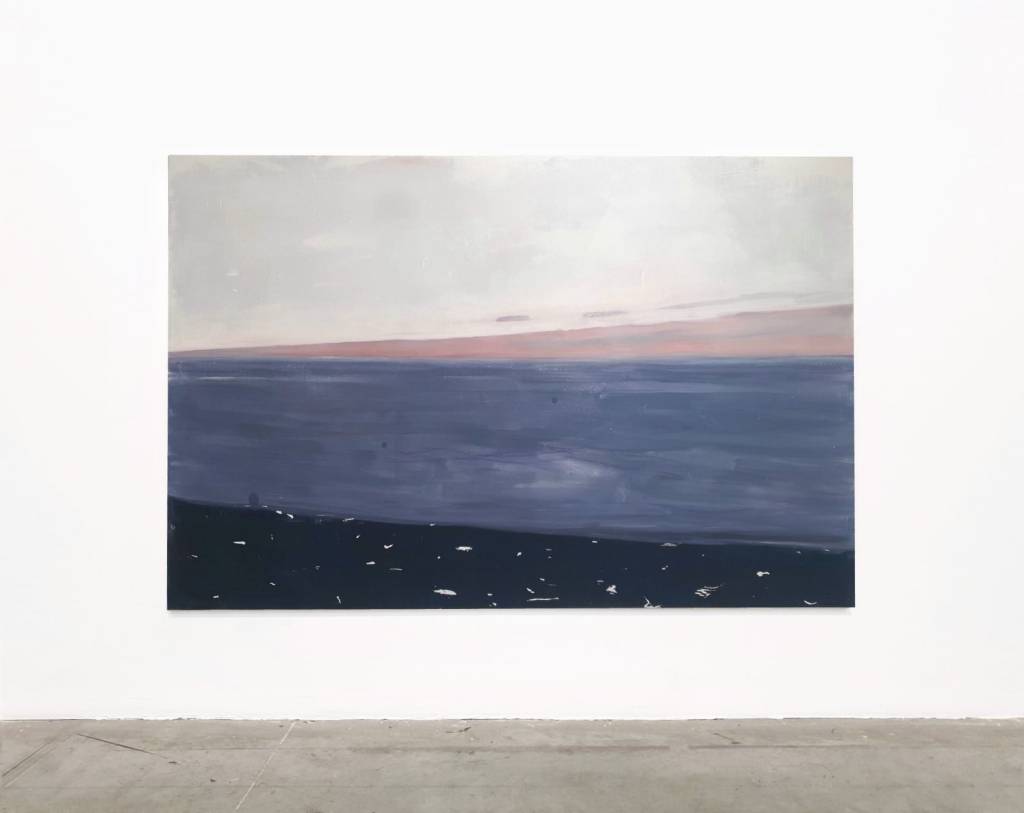
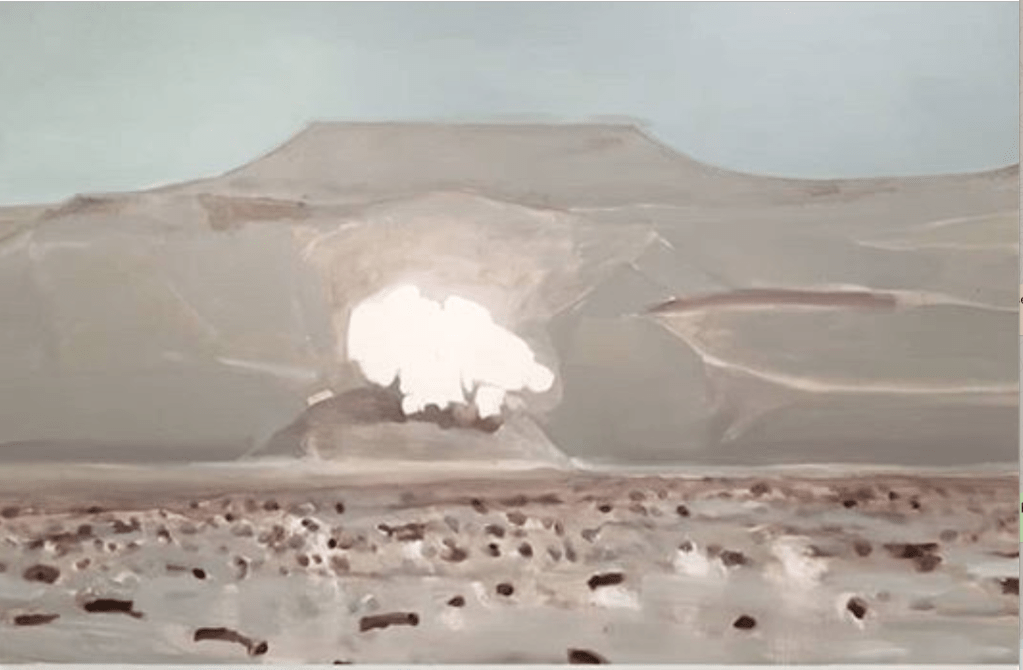
In one work we see eerily beautiful in beige hues a crater landscape in front of the panorama of a stony desert. In another, against the backdrop of a romantic seascape, we see a beach dotted with black sand. In another work, a dark, powerful, destructive cyclone builds up like an atomic bomb. Nature shows in his paintings with irrepressible force and urges us to preserve the vital ecological balance for humans, plants and animals. The beauty of nature staged by Lou Ros is a degree migration of painting between admiration and warning. One can speak of a scary-beautiful painting that leaves our consciousness deeply insecure.
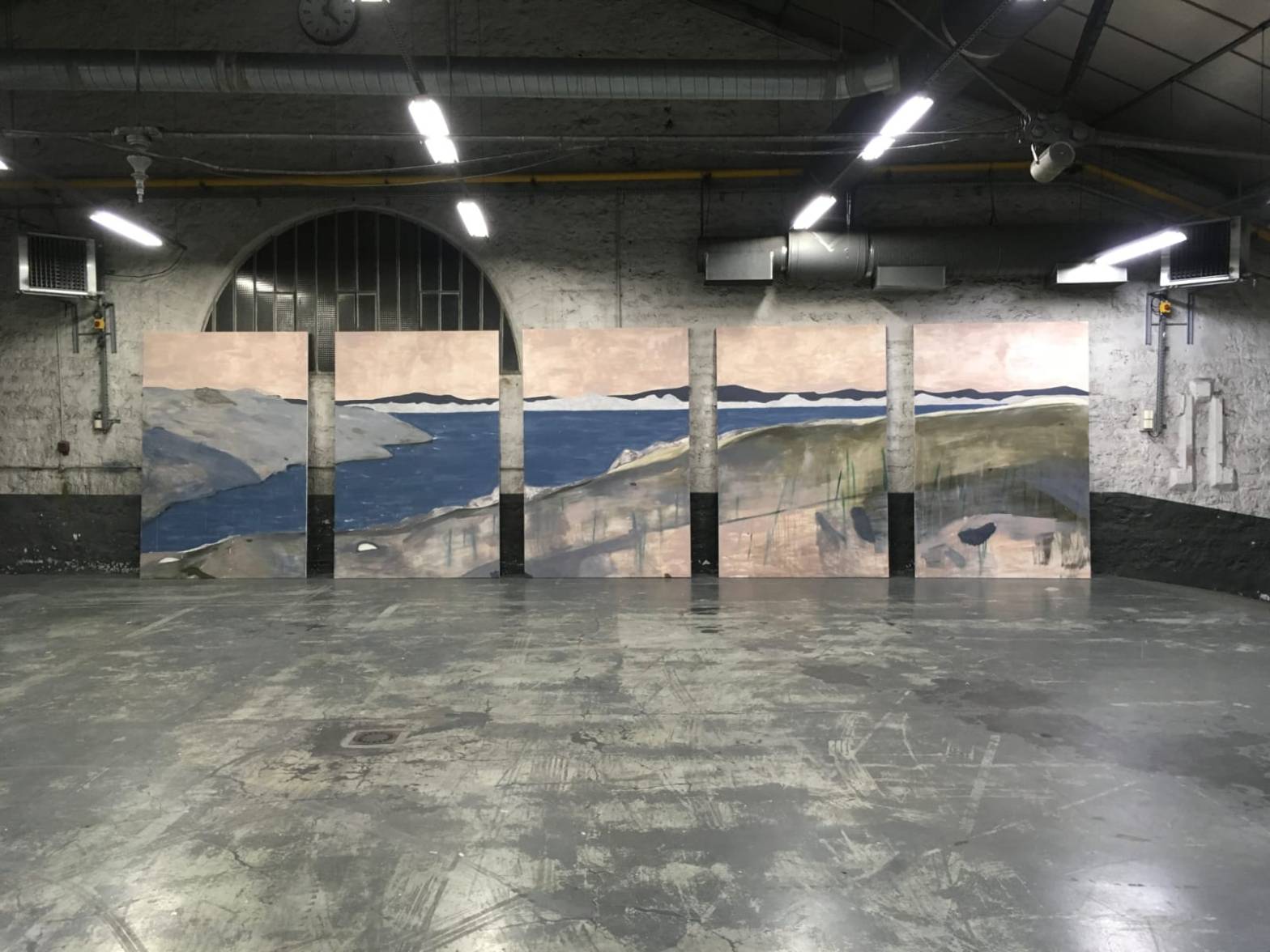
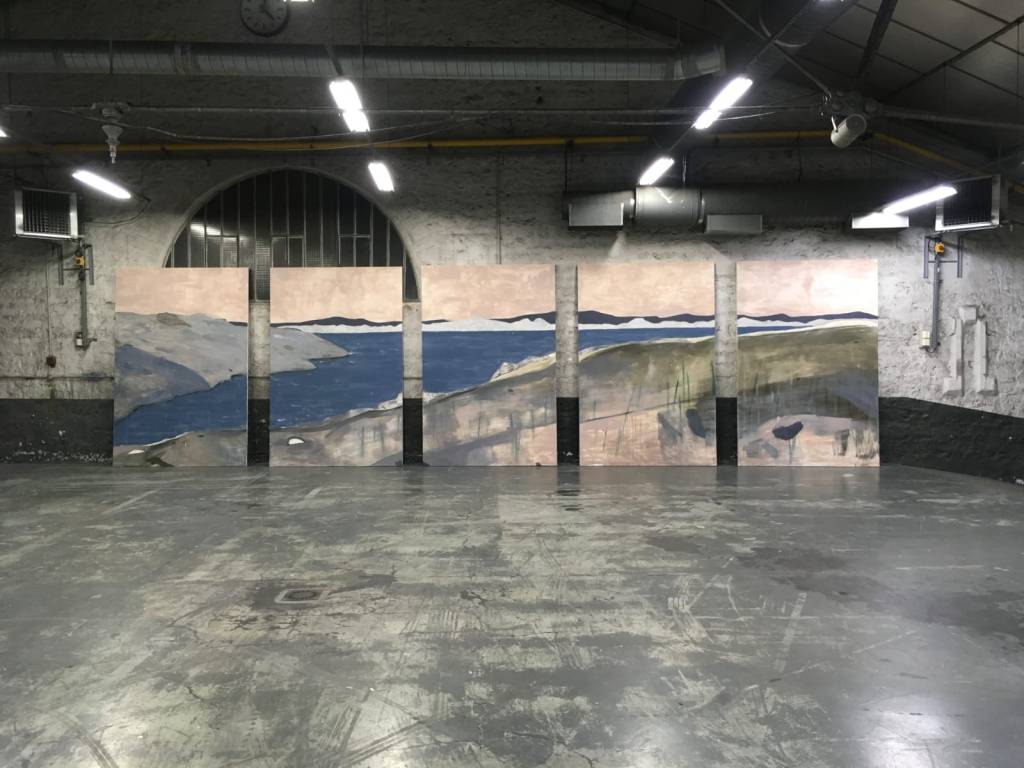
In his latest large-format work, entitled „Littoral“, which will be exhibited in Paris and has dimensions of 3 x 10 meters, Lou Ros celebrates the special aura and beauty of the Îles de Frioul (Frioul Islands) near Marseille in France South France. The sparse plant world reflects the special natural situation of the dry rocky landscape by the sea in the south of France, but appears in the panels rather as a souvenir of a disappearing, almost deserted, intact nature. In painting, however, we no longer see nature with her blooming, colorful face, but the colors are dull and the mountains show a lifeless gray-in-gray. Joseph Beuys spoke very impressively of a „room that tends to cold“ in his installation „Lightning struck with light on deer“ from 1985 (Museum für Moderne Kunst Frankfurt). This description also fits in with some of Lou Ros’s landscapes, which provide us with a mirror of reality that we do not yet really want to admit, even though it is already deeply rooted in our collective memory.
Where did the sensitively painted landscapes of the artist come from, which proclaim a kind of „renaissance of abstraction“?
For many years, Lou Ros has successfully developed portrait paintings that take the human face or the figure as a starting point for painterly expression. His portraits are not comparable to such as Alex Katz’s flattened „Billboard Paintings“, which depict the general and brushwork of advertisers typing a face on large-format screens, but his painted faces reveal mood portraits of people of various backgrounds. Some of the works are refined to character studies, some are reduced to a few incisive features, others are bathed in a monochrome color mood and make a face shimmer like visionary portraits behind a curtain. Some pictures are constructed using the technique of sampling, others show blurred faces, anonymous persons. The motives come partly from well-known, partly from private persons. Lou Ros tries to approach the character of a person or the appearance he feels. And so the artist decides with each portrait for a certain expression, which can be formal or coloristic, as required by the respective mood or the specific expression.
And here, portrait and landscape meet in terms of painting and content. In a portrait, a person’s face becomes an expression, a character study, a mood image, just as a landscape through a certain colourfulness, an open brushwork and a well-dosed abstraction becomes a mood of nature today.
Perhaps that is what Lou Ros wants to tell us in a forceful way that man and nature interact and influence each other, that when we destroy nature, we destroy ourselves, and with certain choices we can influence our lives, the survival of nature and the future of the earth. Painting has an unbelievable power to make people aware of something profound, unlike reports and film reports. The medium of painting shows more than any other media the truth of existence and can sometimes be very subtle, but sometimes also vehemently thought-provoking about what was what is and what might be. The messages of painting are just more sustainable, deeper, sensitive, auratic, and thus different, as it can be medial images. Andy Warhol has shown this with his magnificent pictures of serial motifs and a painter like Lou Ros brings us back to ourselves and to our origin in nature.
Rolf Lauter, Zürich, October 2019
Rolf Lauter – Lou Ros – La Renaissance de l’abstraction 10/2019
„Le véritable artiste aide le monde en révélant des vérités mystiques„ Bruce Nauman
Depuis les origines de l’humanité, la peinture et son expressivité, déterminées par l’identité subjective, sont nos véritables et les plus honnêtes compagnons dans le contexte des processus d’imagination rituels, religieux, magiques, mystiques, spirituels, émotionnels, imaginaires et créatifs. La peinture est donc une expression picturale de la réalité intérieure extérieure visible ou imaginative d’un être humain. Avec elle, l’artiste pénètre dans les zones les plus profondes de la conscience et de l’inconscient, de la créativité, de la considération de la réalité, du visionnaire, du pensable ou de l’indiciable. Et bien que la fin de la peinture ait souvent été postulée, les artistes réinventent constamment de nouveaux chemins, processus de création et possibilités d’expression afin de montrer visuellement aux gens leur vérité, leur désir, leur passion, leur conception critique ou leur vision du monde.
Même si la photographie, la vidéo, l’animation ou les nouveaux médias progressent en général jusqu’au plus profond des microcosmes, des macrocosmes, des mondes réels et virtuels à l’aide des techniques les plus récentes, même si la sculpture continue à se développer par l’enrichissement de l’objet ou l’installation de l’espace pour intervenir dans les domaines de la réalité factuelle ou pour la simuler métaphoriquement et même si l’architecture a élargi la frontière de manière révolutionnaire en raison de développements technologiques complexes, rien ne s’approche de la signification de la peinture dans sa fonction unique, authentique, créée par l’homme. Hans Georg Gadamer a décrit de manière impressionnante cette unicité et la véracité de l’image dans son célèbre texte „Vérité et méthode“ en utilisant l’herméneutique. Grâce au dialogue mutuel entre l’image et le spectateur, il a thématisé et progressivement élaboré les concepts de vérité, de signification, de connaissance et de compréhension.
Comment l’image artistique est-elle différente de tous les autres mondes picturaux?
Chaque jour, nous sommes exposés à un flot d’images, d’événements, de processus, d’informations, réels ou virtuels, que notre conscience et notre subconscient peuvent difficilement manipuler. La vitesse des mondes d’images et d’images générés par ordinateur est en train de structurer et de déterminer aujourd’hui plus que jamais notre vie, notre vie civilisatrice. Dans son livre « L’Inertie polaire, Essai. » Bourgois, Paris 1990), Paul Virilio a décrit de manière urgente la manière dont un être humain se trouve confronté à un flot croissant d’images et d’informations audiovisuelles dans l’environnement de travail et le monde privé et alors s‘établie progressivement dans un état de stagnation, l’immobilité. L’écran devient un substitut de la réalité et évoque une omniprésence permanente de la présence universelle dans le voisinage immédiat. „L’ordre de succession“ est de plus en plus remplacé par le „désordre de la simultanéité“. L’espace tridimensionnel physiologiquement tangible et ses distances spatio-temporelles, d’une part, et les événements réels successifs, d’autre part, sont filtrés de la réalité tangible et condensés dans une simultanéité virtuelle bidimensionnelle sur nos grands ou petits écrans. Les lois de l’espace et du temps sont en quelque sorte abolies et l’être humain perd de plus en plus le rapport à la réalité sensible. Il s’éloigne à un rythme effréné de son naturel et donc de sa perception sensuelle, esthétique et authentique.
Et c’est là que la peinture et l’image créée par un artiste jouent un rôle essentiel dans notre compréhension du monde. Initialement, une image est un support dans sa fonction et rend quelque chose en retour, ce qu’elle n’est pas elle-même. Par sa nature, une peinture est tout d‘abord une toile, une civière et de la couleur, rien de plus. En termes de contenu, chaque image peinte est unique, créée par un artiste. La peinture médiatique est, pour ainsi dire, le médiateur entre l’artiste et le spectateur, c’est-à-dire la plate-forme de dialogue entre eux. Et juste en raison de son unicité, de son authenticité, de son individualité, l’image peinte se distingue de toute autre image reproduite en photographie, en vidéo ou en support numérique. Dans son brillant essai intitulé „L’œuvre d’art à l’ère de la productibilité technique“ (1936), Walter Benjamin a expliqué cette signification particulière de l’œuvre d’art dans la haute éloquence linguistique. Selon Walter Benjamin, l’œuvre d’art déploie sa propre aura particulière, créée à partir des expériences spatiales et temporelles stockées dans celle-ci en tant qu’expression visuelle. La signification de l’unicité de l’image, issue de „l’ici et maintenant“ du processus de création, développe donc un effet spécifiquement magique et auratique qu’aucun autre moyen ne peut déployer.
Lou Ros utilise ce moment „auratic“ de la peinture de manière impressionnante afin de transmettre au spectateur de ses images des messages spécifiques de manière subtile et picturale. En premier lieu, l’artiste s’intéresse à la peinture, une peinture qui mobilise les couleurs appliquées sur la toile de manière essentiellement à grande échelle, coulante et parfois avec des contours délicats accentués par des „icônes“ de la nature, du devenir et du passage. Cela est particulièrement vrai pour son nouveau groupe de «Paysages». La couleur, nourrie par le pouvoir du symbole, devient la source d’énergie et l’image miroir des vastes processus d’un changement insidieux et peut-être imparable de la nature, qui passe de la beauté organique à la matière hagard, morbide et morte. Au premier coup d’œil, nous voyons des couchers de soleil sur des horizons doux, des montagnes beiges, des plages de sable ou une mer bleue. Il semble même qu’il y ait une touche de romance au-dessus des images de paysages. Lou Ros utilise le principe de l’imprécision dans ces paysages , la douceur dans l’expression picturale, afin de diriger davantage la conscience du spectateur sur le sujet qu’il désire. Gerhard Richter a développé cette technique de manière magistrale dans de nombreux travaux, notamment dans sa série d’images sur les événements de Stammheim le « 18. Octobre 1977» https://de.wikipedia.org/wiki/18._Octobre_1977
Les peintures de Lou Ros sont virtuoses et élaborées dans une forme d’abstraction suprême: l’artiste réduit le sujet „nature“ à l’essentiel, c’est-à-dire à des images superflues, extrêmement simplifiées, des zones de couleur peintes doucement qui, dans des tons très mélangés, développent une expression très naturelle. Ainsi, l’artiste n’indique pas tant un endroit ou un objet spécifique dans l’image, mais cherche plutôt à ressentir un état dans la nature et à l’exprimer avec une sensualité émotionnelle. La nature se développe dans la peinture de Lou Ros comme des ambiances métaphoriquement condensées, qui évoquent des souvenirs d’expériences positives de la nature, tandis que, de plus près, un sentiment de vulnérabilité rampant et désagréable surgit dans notre monde et nous semblons faire face à des forces apparemment incompatibles.
Dans une œuvre, on voit étrangement belle dans les teintes beiges un paysage de cratère devant le panorama d’un désert caillouteux. Dans un autre, sur fond de paysage marin romantique, nous voyons une plage parsemée de sable noir. Dans un autre travail, un cyclone sombre, puissant et destructeur se construit comme une bombe atomique. La nature apparaît dans ses peintures avec une force irrépressible et nous invite à préserver l’équilibre écologique vital pour les humains, les plantes et les animaux. La beauté de la nature mise en scène par Lou Ros est un degré de migration de la peinture entre admiration et avertissement. On peut parler d’un tableau effrayant-magnifique qui laisse notre conscience profondément insécurisée.
Dans sa dernière œuvre grand format, intitulée „Littoral“, qui sera exposée à Paris et mesurera 3 x 10 mètres, Lou Ros célèbre l’aura et la beauté des îles de Frioul près de Marseille dans le sud de la France. Le monde végétal clairsemé reflète la situation naturelle particulière du paysage rocheux sec au bord de la mer dans le sud de la France, mais apparaît dans les panneaux plutôt comme un souvenir d’une nature intacte en voie de disparition, presque déserte. En peinture, cependant, nous ne voyons plus la nature avec son visage épanoui et coloré, mais les couleurs sont ternes et les montagnes présentent un gris sans vie. Joseph Beuys a parlé de manière impressionnante d’une „pièce qui a tendance à froid“ dans son installation „Lightning frappée de lumière sur un cerf“ de 1985 (Museum für Moderne Kunst Frankfurt). Cette description s’inscrit également dans certains paysages de Lou Ros, qui nous offrent un miroir de réalité que nous ne voulons pas encore admettre, même s’il est déjà profondément enraciné dans notre mémoire collective.
D’où viennent les paysages peints avec sensibilité de l’artiste, qui proclament une sorte de „renaissance de l’abstraction“?
Depuis de nombreuses années, Lou Ros a développé avec succès une peinture de portrait qui prend le visage humain ou la figure comme point de départ pour une expression picturale. Ses portraits ne sont pas apparus tels que les „Billboard Paintings“ aplatis d’Alex Katz, qui représentent le portrait général et le travail au pinceau d’annonceurs tapant un visage sur des écrans grand format, mais ses visages peints révèlent des portraits d’humeur de personnes de divers horizons. Certaines des œuvres sont raffinées pour étudier le caractère, certaines sont réduites à quelques traits incisifs, d’autres sont baignées dans une couleur monochrome et font miroiter un visage comme derrière un rideau. Certaines images sont construites à l’aide de la technique d’échantillonnage, d’autres montrent des visages flous, des personnes anonymes. Les motifs viennent en partie de personnes connues, en partie d’inconnus. Lou Ros essaie d’approcher le caractère d’une personne ou l’apparence qu’il ressent. C’est ainsi que l’artiste décide avec chaque portrait d’une expression particulière, qui peut être formelle ou coloristique, en fonction des ambiances respectives ou de l’expression spécifique.
Et ici, portrait et paysage se rencontrent en termes de peinture et de contenu. Dans un portrait, le visage d’une personne devient une expression, une étude du personnage, une image de l’humeur, tout comme un paysage à travers une certaine couleur, un pinceau ouvert et une abstraction bien dosée devient aujourd’hui une humeur de la nature.
C’est peut-être ce que Lou Ros veut nous dire avec force que l’homme et la nature interagissent et s’influencent mutuellement, que lorsque nous détruisons la nature, nous nous détruisons nous-mêmes et, avec certains choix, nous pouvons influencer nos vies, la survie de la nature, l’avenir de la terre. La peinture a un pouvoir incroyable pour sensibiliser les gens à quelque chose de profond, contrairement aux documentations et aux reportages de film. Le médium de la peinture montre plus que tout autre médium la vérité de l’existence et peut parfois être très subtil, mais aussi parfois susciter avec véhémence une réflexion sur ce qui était et peut être. Les messages de la peinture sont simplement plus durables, plus profonds, sensibles, auratiques, et donc différents d’images médiales. Andy Warhol l’a montré avec ses magnifiques images de motifs en série et un peintre comme Lou Ros nous ramène à nous-mêmes et à notre origine dans la nature.
Rolf Lauter
Zurich, Octobre 2019
Rolf Lauter – Lou Ros – Die Renaissance der Abstraktion 10/2019
“The true artist helps the world by revealing mystic truths” Bruce Nauman
Die Malerei und ihre von subjektiver Identität bestimmte Ausdruckskraft ist seit den Ursprüngen der Menschheit ihr wahrhaftigster und ehrlichster Begleiter ritueller, religiöser, magischer, mystischer, geistiger, emotionaler, realitätsbezogener oder aus der Phantasie stammender Vorstellungs- und Gestaltungsprozesse. Malerei ist somit bildnerischer Ausdruck der sichtbaren äusseren oder der imaginativen inneren Wirklichkeit eines Menschen. Mit ihr dringt der Künstler in die tiefsten Bereiche des Bewusstseins und Unbewusstseins, der Kreativität, der Realitätsbetrachtung, des Visionären, des Denkbaren oder des Unaussprechbaren vor. Und obwohl schon oft das Ende der Malerei postuliert wurde, erfinden Künstler immer wieder neue Wege, gestalterische Prozesse und Ausdrucksmöglichkeiten, um den Menschen ihre jeweils individuelle Wahrheit, Sehnsucht, Leidenschaft, kritische Vorstellung oder Weltsicht bildnerisch vor Augen zu führen.
Auch wenn sich die Fotografie, der Videofilm, die Animation oder neue Medien generell mit Hilfe von neuesten Techniken in die tiefsten Tiefen der Mikro- und Makro Kosmen, der realen und virtuellen Welten vorarbeiten, die Skulptur durch die Bereicherung des Objekts oder der Rauminstallation immer weiter in die Bereiche der faktischen Realität eingreift oder diese metaphorisch simuliert und die Architektur aufgrund von aufwendigen technologischen Entwicklungen bahnbrechende Grenzerweiterungen geleistet hat, kommt doch nichts auch nur annähernd an die Bedeutung des Bildes in seiner Funktion als einzigartiges, authentisches, vom Menschen geschaffenes Unikat heran. Hans Georg Gadamer hat diese Einzigartigkeit und Wahrhaftigkeit des Bildes in seinem berühmten Text «Wahrheit und Methode» unter Anwendung der Hermeneutik eindrucksvoll beschrieben, indem er durch den wechselseitigen Dialog zwischen Bild und Betrachter die Begriffe Wahrheit, Sinn, Erkenntnis und Verstehen thematisiert und stufenweise herausgearbeitet hat.
Wie unterscheidet sich nun das künstlerische Bild von allen anderen Bildwelten?
Wir sind täglich einer Flut von realen oder virtuellen Bildern, Ereignissen, Prozessen, Informationen ausgesetzt, die von unserem Bewusstsein und Unterbewusstsein kaum bewältigen werden können. Die Geschwindigkeit der computergenerierten Informationen und Bildwelten strukturieren und bestimmen heute mehr denn je unser Leben, unseren zivilisatorischen Lebensalltag. Paul Virilio hat in seinem Buch «Rasender Stillstand» (Originaltitel: L’Inertie polaire. Essai. Bourgois, Paris 1990) in eindringlicher Weise beschrieben, wie der Mensch bei einer ständig zunehmenden Flut von audio-visuellen Bildern und Informationen in der digitalen Arbeits- und Privatwelt allmählich in einen Zustand des Stillstandes, der Immobilität gelangt. Der Bildschirm wird Ersatz für Realität und gaukelt uns eine permanente Allgegenwart von universeller Gegenwart in direkter Nähe vor. An die Stelle der «Ordnung der Sukzession» tritt immer mehr die «Unordnung der Simultaneität». Der physiologisch erfahrbare dreidimensionale Raum und mit ihm raum-zeitliche Distanzen auf der einen Seite sowie die sich nacheinander in messbaren Zeiteinheiten ereignenden realen Geschehnisse auf der anderen Seite werden aus der erfahrbaren Wirklichkeit herausgefiltert und in einer virtuellen zweidimensionalen Gleichzeitigkeit auf unseren kleinen oder grossen Bildschirmen verdichtet. Die Gesetzmässigkeiten von Raum und Zeit werden in gewisser Weise aufgehoben und der Mensch verliert immer mehr den Bezug zur sinnlich erfahrbaren Realität. Er entfernt sich mit enormem Tempo von seiner Natürlichkeit und damit auch von seiner sinnlichen, ästhetischen, authentischen Wahrnehmung.
Und gerade hier kommen der Malerei und dem von einem Künstler gestalteten Bild eine wesentliche Rolle für unser Verständnis von Welt zu. Ein Bild ist von seiner Funktion her zunächst ein Medium und gibt etwas wieder, was es selbst nicht ist. Von seiner Beschaffenheit her ist ein Bild Leinwand, Keilrahmen und Farbe, mehr nicht. Von seinem Inhalt her ist jedes gemalte Bild ein Unikat, etwas von einem Künstler geschaffenes Einmaliges. Das Medium Bild ist sozusagen der Mittler zwischen Künstler und Betrachter, also die zwischen beiden befindliche Dialogplattform. Und gerade durch seine Einmaligkeit, Authentizität, Individualität unterscheidet sich das gemalte Bild von jedem anderen reproduzierten Bild in der Fotografie, dem Video oder digitalen Medien. Diese besondere Bedeutung des Kunstwerks hat Walter Benjamin in seinem brillanten Aufsatz «Das Kunstwerk im Zeitalter seiner technischen Produzierbarkeit» (1936) in hoher sprachlicher Eloquenz herausgearbeitet. Das Kunstwerk entfaltet nach Walter Benjamin seine eigene besondere Aura, die aufgrund der in ihm als bildnerischem Ausdruck gespeicherten Raum- und Zeiterfahrungen entsteht. Die Bedeutung der Einmaligkeit des Bildes, entstanden aus dem «Hier und Jetzt» des Gestaltungsprozesses, entwickelt damit eine spezifisch magische und auratische Wirkung, wie sie kein anderes Medium entfalten kann.
Lou Ros nutzt in eindrucksvoller Weise dieses «auratische» Moment der Malerei, um dem Betrachter seiner Bilder spezifische Botschaften in subtiler und malerisch äusserst sensibler Weise nahe zu bringen. Zuallererst geht es dem Künstler dabei um Malerei, eine Malerei, die die zum Einsatz gebrachten Farben auf der Leinwand in einer meist grossflächig angelegten, fließenden und bisweilen mit zarten Konturen akzentuierten Pinselführung zu «Ikonen» von natürlichem Sein, Werden und Vergehen nobilitieren. Dies gilt besonders für seine neue Werkgruppe der «Landschaften». Farbe wird mit der Kraft der Symbolik gespeist, wird geradezu Energieträger und Spiegelbild von gewaltigen Prozessen eines schleichenden und vielleicht unaufhaltsamen Wandels der Natur von organischer Schönheit zu ausgezehrter, morbider, toter Materie. Dabei sehen wir bei einem ersten flüchtigen Blick weiche Horizonte, beigefarbene Berge, Sandstrände oder blaues Meer im Abendrot und es scheint, als schwebe über den Landschaftsbildern sogar ein Hauch von Romantik. Lou Ros bedient sich bei diesen Landschaftsbildern des Prinzips der Undeutlichkeit, der Weichheit im malerischen Ausdruck, um das Bewusstsein des Betrachters stärker auf die von ihm gewünschte Thematik zu lenken. Gerhard Richter hat diese Technik in vielen Werken meisterhaft entwickelt, so zuletzt in seinem Bilderzyklus zu den Geschehnissen in Stammheim am «18. Oktober 1977» https://de.wikipedia.org/wiki/18._Oktober_1977
Die Bilder von Lou Ros sind dabei virtuos und in einer höchsten Form der Abstraktion ausgearbeitet: Der Bildgegenstand «Natur» wird vom Künstler auf das Wesenhafte reduziert, also auf bildfüllende, extrem vereinfachte, weich gemalte Farbflächen, die in sensibel gemischten Farbtönen einen sehr «natürlichen» Ausdruck entfalten. Damit deutet der Künstler weniger einen spezifischen Ort oder einen spezifischen Gegenstand im Bild an, sondern er versucht vielmehr, einen Zustand in der Natur zu erspüren und mit emotionaler Sinnlichkeit zum Ausdruck zu bringen. Natur wird in der Malerei von Lou Ros gleichsam zu metaphorisch verdichteten Stimmungsbildern entwickelt, die im Betrachter zum einen Gedächtnisbilder eigener positiver Naturerfahrungen hervorrufen, zum anderen entsteht bei genauerer Betrachtung ein schleichendes, unangenehmes Gefühl der Verletzlichkeit unserer Welt und wir werden subtil mit der wachsenden Beeinflussung von scheinbar unumstösslichen Naturgewalten konfrontiert.
In einem Werk sehen wir schaurig-schön in beigefarbenen Farbtönen eine Kraterlandschaft vor dem Panorama einer steinigen Wüste. In einem anderen betrachten wir vor dem Hintergrund einer romantisch anmutenden Meereslandschaft einen Strand, der von schwarzem Sand übersät ist. In einem anderen Werk baut sich ein dunkler, mächtiger, zerstörerischer Wirbelsturm auf, einer Atombombe gleich. Die Natur zeigt sich in seinen Bildern mit unbändiger Kraft und mahnt uns, das für Menschen, Pflanzen und Tiere lebensnotwendige ökologische Gleichgewicht zu bewahren. Die von Lou Ros inszenierte Schönheit der Natur ist eine Gradwanderung der Malerei zwischen Bewunderung und Warnung. Man kann von einer schaurig-schönen Malerei sprechen, die unser Bewusstsein zutiefst verunsichert zurücklässt.
In seinem neuesten in diesem Jahr fertiggestellten grossformatigen Werk mit dem Titel «Littoral», das in Paris ausgestellt wird und die Dimensionen 3 x 10 Meter hat, zelebriert Lou Ros die besondere Aura und Schönheit der Îles de Frioul (Frioul-Inseln) nahe Marseille in Südfrankreich. Die spärliche Pflanzenwelt spiegelt die besondere natürliche Situation der trockenen Felslandschaft am Meer im Süden Frankreichs wider, erscheint in den Bildtafeln allerdings eher als Erinnerungsbild einer im Verschwinden begriffenen fast menschenleeren intakten Natur. In der Malerei sehen wir allerdings die Natur nicht mehr mit ihrem ihr blühenden, farbenfrohen Gesicht, sondern die Farben sind stumpf und die Berge zeigen ein lebloses Grau-in-Grau. Joseph Beuys hat über seine Rauminstallation «Blitzschlag mit Lichtschein auf Hirsch» aus dem Jahr 1985 (Museum für Moderne Kunst Frankfurt) sehr eindrucksvoll von einem «Raum, der sich zur Kälte neigt» gesprochen. Diese Beschreibung passt ebenso auf manche Landschaftsbilder von Lou Ros, die uns einen Spiegel der Realität vorhalten, wie wir sie noch nicht wirklich wahrhaben wollen, obwohl sie bereits in unserem kollektiven Gedächtnis tief verankert ist.
Woher kommen die empfindsam gemalten Landschaftsbilder des Künstlers, die eine Art «Renaissance der Abstraktion» verkünden?
Viele Jahre hat Lou Ros sehr erfolgreich eine Porträtmalerei entwickelt, die das menschliche Gesicht oder auch die Figur zum Ausgangspunkt für malerischen Ausdruck nimmt. Dabei entstanden nicht etwa Porträts wie die flach gemalten «Billboard Paintings» eines Alex Katz, die das Allgemeine und Pinselführung werbemässig Typisierte eines Gesichtes auf grossflächigen Leinwänden zeigen, sondern seine gemalten Gesichter enthüllen Stimmungsporträts von Menschen verschiedener Herkunft. Manche Werke werden zu Charakterstudien präzisiert, manche sind dagegen auf wenige prägnante Merkmale reduziert, wieder andere sind in eine monochrome Farbstimmung getaucht und lassen ein Gesicht wie hinter einem Vorhang durchschimmern. Manche Bilder sind mit der Technik des Samplings aufgebaut, wieder andere zeigen verwischte Gesichter, anonyme Personen. Die Motive stammen teilweise von bekannten, teilweise von unbekannten Personen. Lou Ros versucht sich dem Charakter eines Menschen oder der Erscheinung, die er spürt, anzunähern. Und so entscheidet sich der Künstler mit jedem Porträt für einen bestimmten Ausdruck, der formal oder koloristisch ausgeprägt sein kann, so wie es die jeweilige Stimmung oder der spezifische Ausdruck verlangt.
Und hier begegnen sich Porträt und Landschaft malerisch und inhaltlich. Das Gesicht einer Person wird im Porträt zu einem Ausdruck, zu einer Charakterstudie, einem Stimmungsbild, ganz so, wie eine Landschaft durch eine bestimmte Farbigkeit, eine offene Pinselführung und eine wohldosierte Abstraktion zu einem Stimmungsbild der Natur in der heutigen Zeit wird.
Vielleicht ist es das, was uns Lou Ros in eindringlicher Weise mitteilen will, dass sich Mensch und Natur wechselseitig bedingen und beeinflussen, dass wir, wenn wir die Natur zerstören, uns selbst zerstören und dass wir mit bestimmten Entscheidungen unser Leben, das Weiterleben der Natur und die Zukunft der Erde beeinflussen können. Malerei hat eine unglaubliche Kraft, um den Menschen anders als Reportagen und Filmberichte etwas Tiefempfundenes bewusst zu machen. Das Medium der Malerei zeigt mehr als alle anderen Medien Wahrheit der Existenz und kann die Menschen zum Teil sehr subtil, zum Teil aber auch vehement zum Nachdenken über das was war, was ist und was sein könnte auffordern. Die Botschaften der Malerei sind eben nachhaltiger, tiefer greifend, empfindsam, auratisch, und damit anders, als es mediale Bilder sein können. Andy Warhol hat dies mit seinen grandiosen Bildern von seriellen Motiven gezeigt und ein Maler wie Lou Ros führt uns wieder zu uns selbst und zu unserem Ursprung in der Natur.
Rolf Lauter
Zürich, im Oktober 2019
 Rolf Lauter Art Blog